Why Your Shopify Store Needs an AI Co-Pilot in 2026
Introduction
Shopify has long been a leader in the eCommerce space, but in recent years, it has also positioned itself as a pioneer by centering its web services and offerings on AI (artificial intelligence). Instead of treating AI as an add-on, Shopify is embedding intelligence into its core with every other advancement, such as Shopify Magic, Shopify Inbox AI, and Shopify Sidekick.
Combined with the speed at which consumers demand new features and more immersive experiences, AI for Shopify stores won’t just be a helpful enhancement; it will be critical for growth in 2026 and beyond.
In this blog, we will explore why your Shopify store needs AI in 2026 and how this technology will improve store performance and increase profitability in the coming years.
Why Your Shopify Store Needs AI in 2026?
The need for AI co-pilots for Shopify stems from a straightforward reality: most stores already have the right platform and data, but they can’t fully leverage either with the team and time they have.
- Execution Bandwidth: Whether launching something new or updating existing collections, campaigns, bundles, landing pages, emails, FAQs, etc., all still require human time. Teams often hit a ceiling on how many experiments, pages, or campaigns they can ship.
- Skills Gap: Code + Strategy in One Place: Most eCommerce teams lack a Shopify developer, a data expert, a CRO specialist, and a content team all in-house. This lack of cross-functional expertise creates room for Shopify AI co-pilots.
- Always-on Operations Without Headcount: Customer tickets, merchandising updates, and design tasks never stop, but your workers do. Moreover, as your store runs 24/7, support, analytics, and minor fixes must be catered to without night shifts or more juniors.
An Overview of Shopify’s AI Co-Pilots and Ecosystem
Shopify is integrating AI into almost every aspect of its platform, making it easier for merchants to manage and scale their stores. From content creation to customer support and fraud prevention, Shopify’s suite of AI tools is designed to automate and optimize any process you think of.
Let us take a closer look at the most prominent AI assistants and co-pilots for Shopify stores:
Shopify Magic

It is a content-focused AI co-pilot for Shopify stores, allowing merchants to automate the generation of high-quality product descriptions, marketing copy, SEO content, and more. Built on GPT-like AI models, it produces text, edits product images, and generates marketing copy with minimal input. Here is an example:
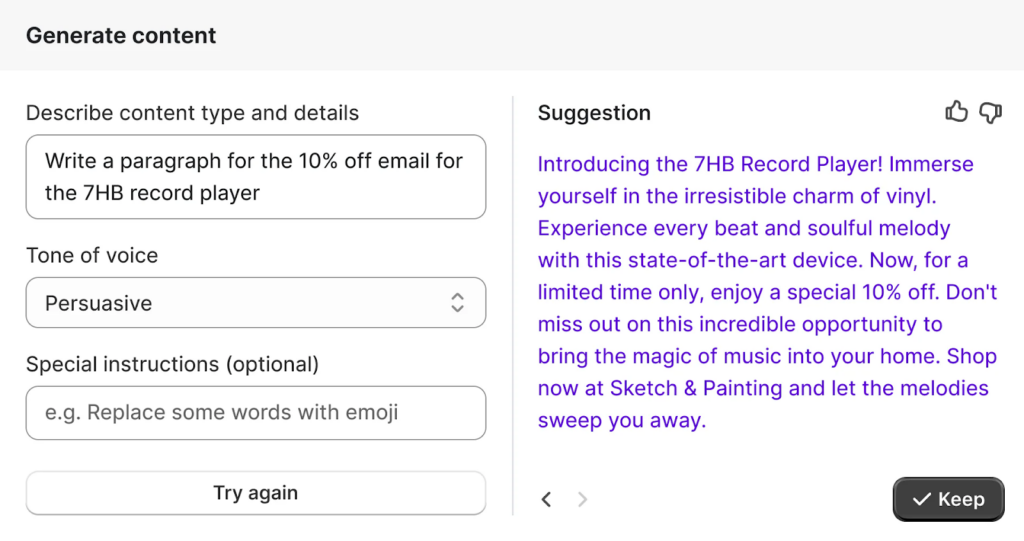
Source: Shopify
Key Benefits of this AI co-pilot for Shopify:
- Cut manual writing time for product, SEO, and marketing copy.
- Standardize tone and structure across thousands of SKUs.
- Reduce dependency on agencies/freelancers for routine content.
- Accelerate testing of new offers and landing pages with fast copy iterations.
Top Use Cases:
- Product Launches: Launching a new collection by auto-generating descriptions + meta titles for let’s say, 200+ products in one sitting.
- Content Revamp: Rewriting underperforming product pages in a more conversion-focused style (e.g., “benefit-first” format).
- Email Campaigns: Promotional email copy or newsletters with AI-driven suggestions.
Shopify Sidekick
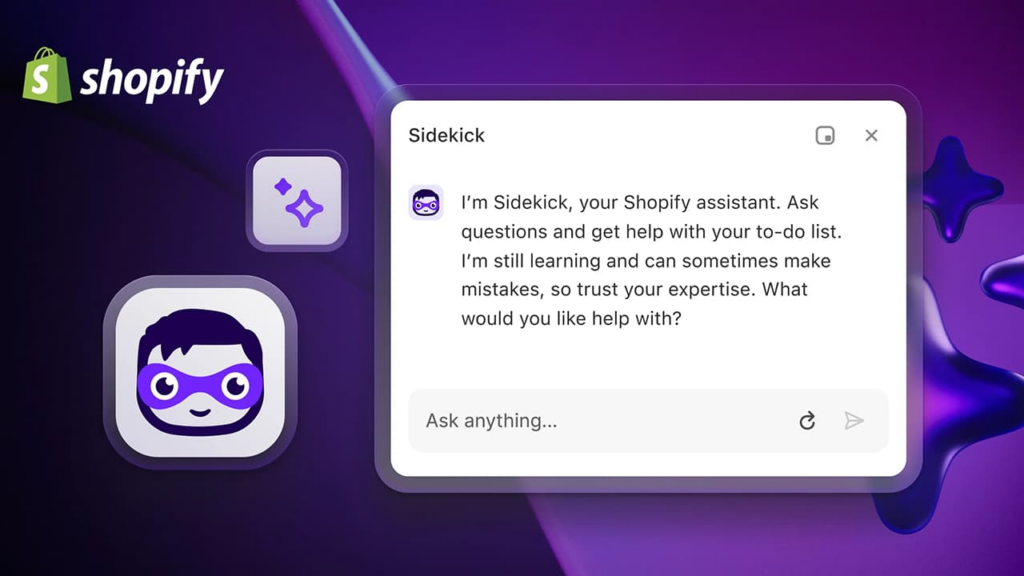
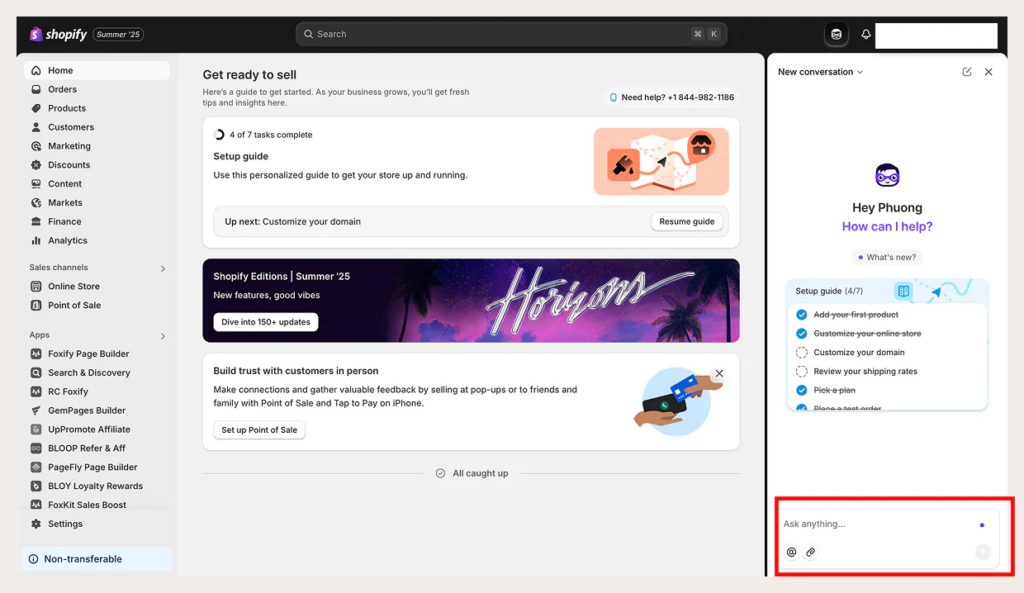
This AI co-pilot for Shopify doubles as a business assistant admin. You ask it questions (“Why did sales dip last week?”) or give it commands (“Create a BFCM discount campaign and apply it to these collections”), and it works on your live store data, settings, and themes accordingly. You can locate Sidekick at the bottom right corner of your store dashboard, as shown in the image below:
Key Benefits of this Shopify AI assistant for eCommerce operations:
- Single conversational interface for operations, analytics, and configuration.
- Faster onboarding for new staff as Sidekick already “knows” how Shopify works.
- Data-driven suggestions (pricing, campaigns, merchandising) without a data team.
Top Use Cases:
- Configuring a site-wide action. For example, having it draft and configure a sitewide sale (discount rules, announcement bar copy, email draft).
- Prompt-based adjustments. “Redesign my homepage to highlight bundles and move reviews above the fold,” and let it adjust theme sections/layout.
Shopify Store Builder
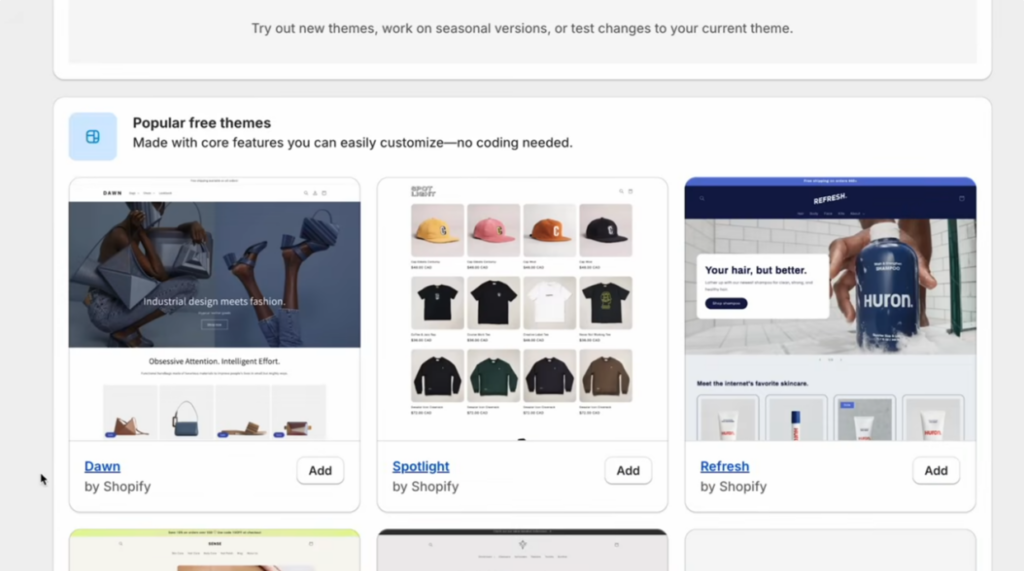
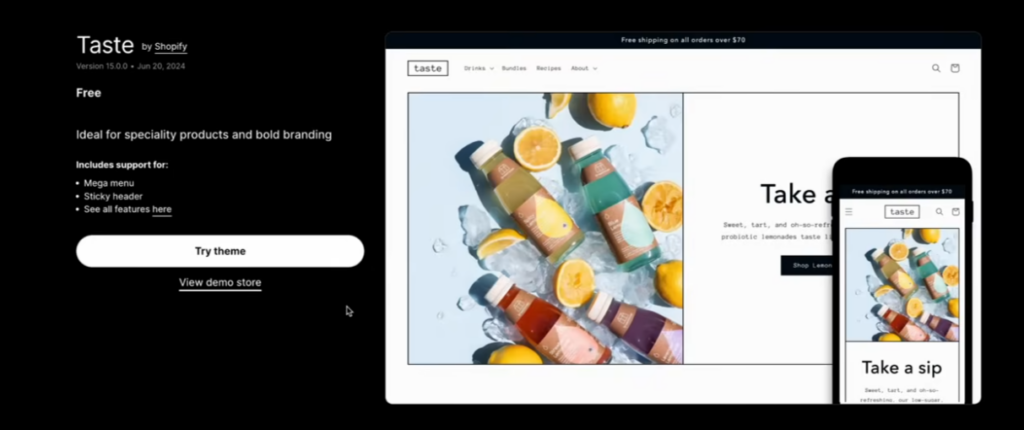
This AI co-pilot for Shopify generates a complete storefront theme—layouts, sections, copy, and imagery—using generative AI. Rather than providing it as a separate extension/SaaS add-on, it is directly integrated into the website/store builder workflow so that merchants can easily explain what they want using short text descriptions.
Key Benefits of this AI co-pilot for Shopify:
- Compresses initial store setup from days/weeks to hours.
- Gives non-designers a conversion-ready layout from day one.
- Reduces the cost of the first version (no theme developer or designer needed initially).
To Use Cases:
- Brand Launch: “Create a store for a mid-range minimalist skincare brand for women 25–40 in the US” → get 3 complete theme options with imagery and copy to refine.
- Creating Alternate Layouts: Quickly generate a new homepage concept focused on specific goals (e.g., subscription plans, best-selling SKUs, new arrivals) and test it before committing resources to manual design.
Shopify Inbox AI
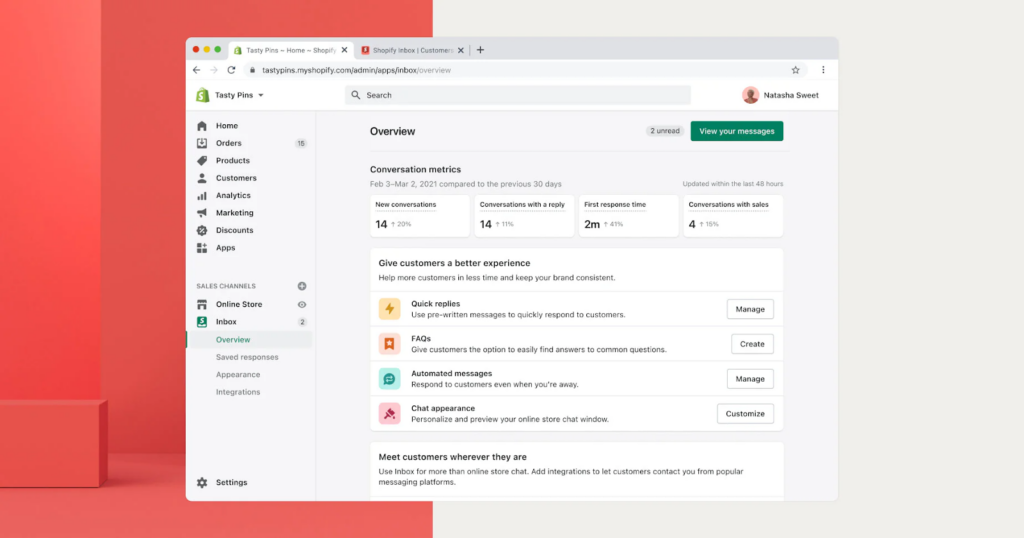
Inbox is Shopify’s built-in AI co-pilot, now enhanced with more intelligent features for instant answers and suggested replies across storefront chat and some social channels. It also centralizes customer conversations inside Shopify and uses personalized user data (cart, viewing history, orders) to respond intelligently. Here is what
Key Benefits of Using AI for Shopify Stores:
- Faster first response times without scaling headcount.
- Consistent answers to repeat questions (shipping, returns, sizing, etc.).
- Higher conversion from on-site chat by nudging visitors with timely, relevant replies and product suggestions.
Top Use Cases:
- Auto-FAQ: AI responds instantly to “Where is my order?,” “Do you ship to Canada?,” “What’s your return policy?” using your policies + live order data.
- Off-hours support: AI handles basic queries overnight, collecting email addresses and phone numbers for human follow-up when needed.
Shopify’s Internal Search and Recommendation System
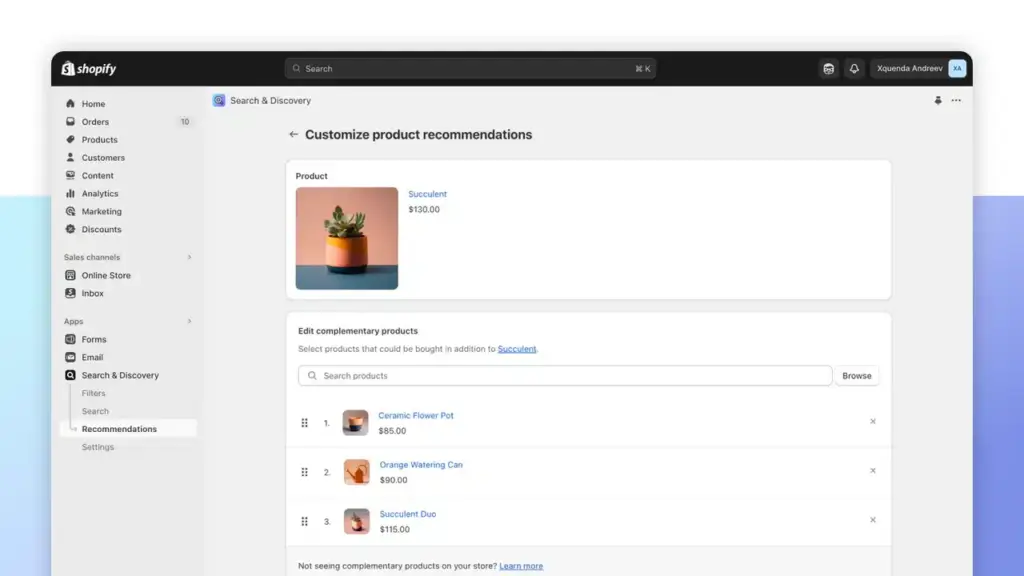
The potential of Shopify store automation with AI can also be experienced through its on-site search system and product recommendations. The platform uses ML models to interpret shopper queries, rank products, and then suggest.
Moreover, after acquiring Vantage Discovery, Shopify has also incorporated semantic search technology that understands customer intent rather than just keywords. This produces more accurate search results and product recommendations, especially for stores with large or complex catalogs.
Key Benefits of this AI co-pilot for Shopify:
- Higher conversion from search sessions because queries return products that match intent, not just matching words.
- Reduced zero-result searches, improving product discovery for long-tail catalogs.
- Lift in AOV through smarter, behavior-driven upsell and cross-sell placements.
Top Use Cases:
- Semantic Product Search: A customer types “gifts for dog moms under $50,” and the search returns relevant SKUs with correct price segmentation, instead of requiring perfect keyword matches.
- AI-Driven Merchandising: When inventory levels change (e.g., a top-seller is low stock), search and recommendation blocks automatically adjust which products are prioritized.
Shopify’s AI for Analytics and Fraud Detection
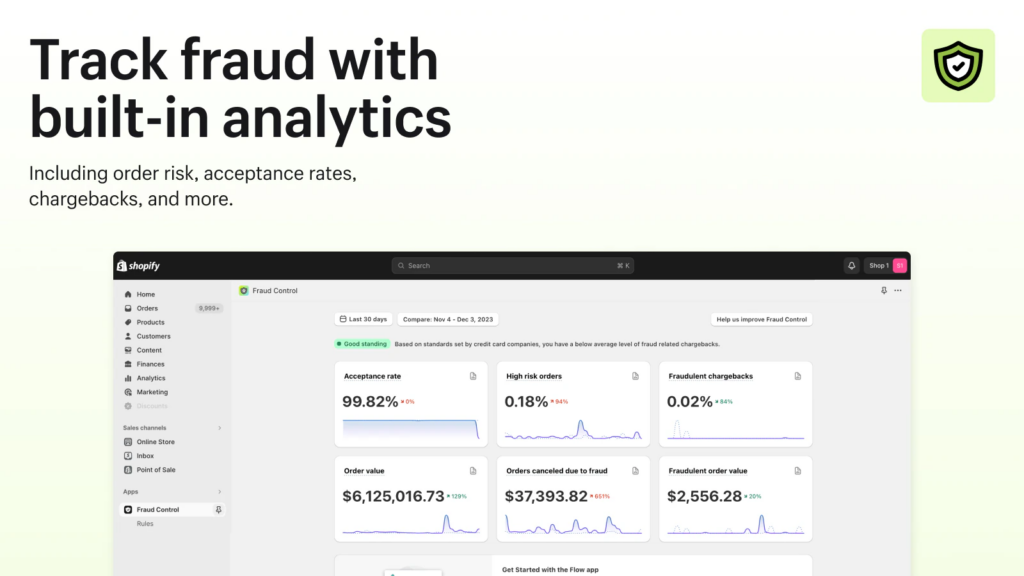
Shopify also provides an AI assistant for eCommerce analytics and fraud detection. This assistant uses ML models to monitor all transactions, identify out-of-the-box behavior, and provide insights into store performance.
Key Benefits of this AI Assistant for eCommerce Operations on Shopify:
- Detects fraudulent transactions in real-time, reducing chargebacks and losses.
- Offers predictive insights into store performance, helping merchants make data-driven decisions.
- Automates the analysis of sales trends, inventory needs, and customer behavior.
Top Use Cases:
- Identifying Sales Opportunities: Analyzing sales patterns to predict which products will sell best in the upcoming season.
- Data Visualization and Reporting: Generating reports on customer buying behavior to optimize marketing campaigns.
The Benefits of Using AI for Shopify Stores in 2026
In the coming months, AI will directly impact your revenue, costs, and capacity. You can experience the following concrete benefits of using AI for Shopify stores:
Higher Conversions
AI-powered search and upsell recommendations can boost search revenue, significantly increase conversion, and increase AOV by as much as 369%.
Lower Support Load
AI co-pilots like Shopify Inbox can cut routine support tickets, freeing your team to handle high-value issues. In fact, live chat support can deflect more than a third of inbound tickets while improving response timelines for the rest.
More Output with the Same Team
Generative tools (e.g., Shopify Magic) can reduce time spent on content creation and merchandising, allowing you to launch more campaigns and products without additional headcount. Teams using genAI can expect as much as 30–50% time reduction.
Reduced Checkout Abandonment
With AI co-pilots for Shopify, you can replace manual reporting with AI-generated insights. Merchants gain instant visibility into:
- Underperforming SKUs
- Pricing issues
- Margin leakage
- Campaign waste
This effectively provides “analyst-level” insight without expanding the team.
Lower Fraud Losses and Fewer Chargebacks
Shopify’s AI assistant for eCommerce fraud detection and analytics gives insights into user-specific actions. Moreover, tools like Shopify Protect (for eligible Shop Pay transactions) can validate transactions using this data and shift chargeback liability from the merchant to Shopify for qualifying orders.
Resilience During Talent Freezes
Now that companies are pulling back on hiring people as automation has started yielding efficiency ROI, AI co-pilots for Shopify can help your business growth even in a hiring-constrained environment.
By combining execution speed, more efficient operation, and freed-up resources, AI co-pilots for Shopify take you one step closer to autonomous operations.
Future of AI Automation for Shopify Stores
The need for custom Shopify automation solutions is no longer restricted to adding “more tools.” It has instead called for embedded AI co-pilots that use what you already have in Shopify: data, traffic, and catalog to close the gaps in execution, analysis, personalization, and capacity. These Shopify AI co-pilots enable your store to ship faster and operate with a leaner team, while improving conversions and retention.
In the coming years, you can expect agentic capabilities in these AI co-pilots for Shopify stores: systems that not only recommend actions but also execute them. This equals automated campaign launches, dynamic product positioning based on performance, real-time pricing adjustments, and proactive alerts without you having to sign up for them.
Whether you configure these abilities yourself or seek professional assistance (workflow automation or AI chatbot development for Shopify), competitive edge in 2026 belongs to merchants who adopt AI early and treat it as core infrastructure—not an add-on.
Author bio
Amelia Swank is a seasoned Digital Marketing Specialist at SunTec India with over eight years of experience in IT industry. She excels in SEO, PPC, and content marketing, and is proficient in Google Analytics, SEMrush, and HubSpot. She is a subject matter expert in Application Development, Software Engineering, AI/ML, QA Testing, Cloud Management, DevOps, and Staff Augmentation (Hire mobile app developers, hire WordPress developers, and hire full stack developers etc.). Amelia stays updated with industry trends and loves experimenting with new marketing techniques.
References: