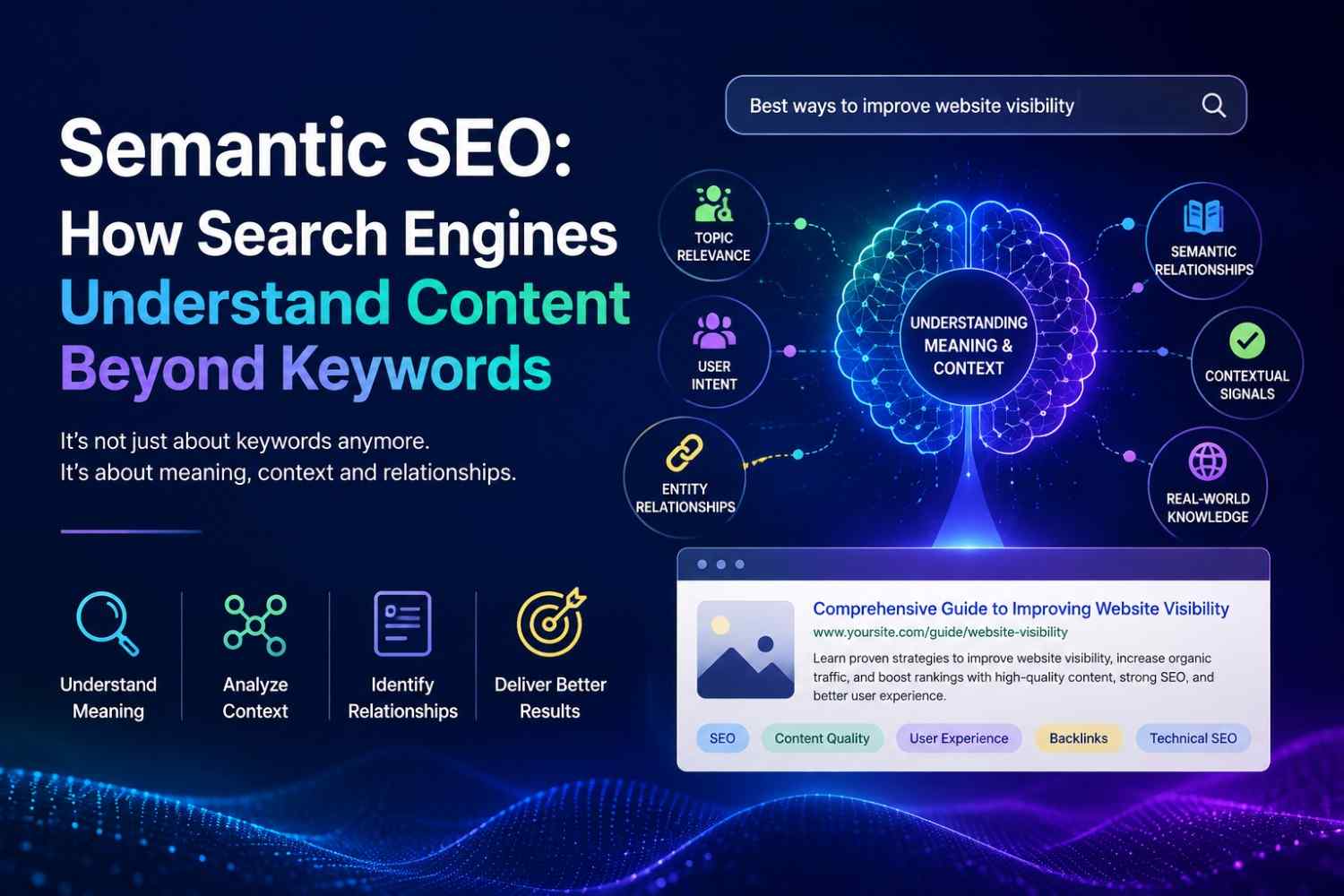
Semantic SEO: How Search Engines Understand Content Beyond Keywords
Semantic search engine optimization is a practical content optimization approach that centers on content meaning and user search intent, rather than strict keyword matching. Modern search engines rely on AI models such as BERT and knowledge graphs to interpret context, connections between concepts, and natural language. For e-commerce businesses, this requires creating authoritative, clear structured content that covers related entities and user questions, applying schema markup, and delivering strong performance across all device types.
Why Semantic Search Has Rewritten the SEO Rulebook
Google’s launch of BERT in 2019 marked a major shift in the logic search engines use to process language. BERT enables search systems to interpret user queries as complete phrases, taking into account the context and connections between words, instead of splitting searches into isolated terms, so it can understand users’ real needs far more accurately.
For PrestaShop merchants, this will completely rewrite the logic you use to write product and category content.
Take a waterproof cycling jacket as an example: traditional keyword-based SEO repeatedly stuffs the phrase “waterproof cycling jacket” into content, while semantic SEO covers a much more complete set of product attributes: breathability, packability, wind flaps, taped seams, temperature ratings, and performance differences between heavy and light rain.
At its core, this approach aligns with how users actually think and ask questions. Instead of only fixating on a small handful of keywords, you build connected content that answers all related questions users may have before making a purchase. Your product pages, category pages, and blog posts need to work together: a blog post comparing jacket fabrics, a detailed product page, and a category guide that explains suitable use cases can reinforce a consistent set of product information through internal links and shared context.
PrestaShop’s blog module helps you organize posts into categories and tags, publish supporting content, and deploy structured data, making it much easier to put this framework into practice.
Core Semantic SEO Concepts: Entities, Relationships, and Context
Semantic Search Engine Optimization (Semantic SEO) is built on three interrelated core modules.
The first module is entities, which refer to all people, locations, products, brands, materials, and concepts within a specific niche field. Take a craft coffee shop as an example: the corresponding entities include Arabica beans, Colombia, pour-over kettles, filter papers, and caffeine content. Search engines use systems such as knowledge graphs to clarify the position of these entities within the broader topic.
The second module is relationships, which explain the connection logic between entities. For instance, Arabica beans are produced in Colombia, pour-over kettles need to be paired with filter papers, and Robusta beans have a different caffeine content from Arabica beans. These relationships provide search engines with far richer information than isolated keywords.
The third module is context, which defines the specific meaning of a term under a particular scenario. For example, when the term “light roast” is paired with “breakfast blend”, it refers to a flavor characteristic; when it is paired with “roasting duration”, it refers to a production process.
When it comes to specific implementation in content creation, you must achieve the following:
- Naturally incorporate core entities in your field
- Clarify and explain the valid connections between these entities
- Provide sufficient context to help search engines correctly categorize the page
Category page descriptions are a good starting point for content creation. Do not repeatedly stack target keywords; instead, mention related products, usage scenarios, materials, user questions, and key purchasing considerations.
Differences between semantic SEO and traditional keyword optimization:
Traditional keyword SEO treats search as a matching task: first identify precise phrases, then insert them into product descriptions, category pages, and metadata; semantic SEO, by contrast, focuses on the actual meaning behind these phrases.
Aspect | Traditional SEO | Semantic SEO
Primary target | Exact keyword strings | Topics, entities, and intent
Content approach | Repeat target phrases | Cover related concepts comprehensively
Query example | “wool coat” | “best winter coat for below freezing weather”
Main signal | Exact matches and keyword use | Contextual relevance and entity relationships
This distinction is critical. Today, consumers increasingly use conversational long-tail queries to ask questions, such as “Is this jacket waterproof enough to hold up through a Scottish winter?” These types of demands require content that matches usage scenarios, product materials, and wear plans, rather than pages that only include the keyword “waterproof jacket”. For PrestaShop merchants, it is necessary to optimize product descriptions around real user questions, create supporting content such as care instructions and size guides, and turn blogs into semantic hubs that connect products to broader themes.
Practical Semantic SEO Steps for Your PrestaShop Store
1. Build Topic Clusters Around Product Categories
Treat each product category as a theme rather than an isolated keyword target, use the category page as the core pillar page, and use product pages, blog posts, and FAQ pages as supporting content.
- Identify core entities, such as “leather boots”.
- Sort out and list the related entities of your products, including materials, seasonal suitability, care requirements, size specifications, and styling methods.
- Create supporting content centered on the above entities, and link this content back to the corresponding category pages.
This structure helps search engines recognize that your store covers broad thematic content within a vertical field, rather than being a collection of scattered, unrelated products.
2. Organize content with Schema structured markup
Schema markup converts the core semantics of your content into structured information that search engines can parse.
- Add Product markup that includes SKU, brand, price, and overall composite score when appropriate.
- Add FAQPage markup for common, factual questions about size, material, shipping, and other related topics.
- Add Article markup for blog posts to clearly specify their content, author, and publication details.
Structured data can reduce ambiguous speculation, while also improving how pages appear in search results and AI-powered systems.
3. Restructure internal links into a meaning map
Internal links are more than just navigation tools—they also convey the relationships between pages.
- Link product pages to their corresponding category pages and other highly relevant product pages
- Link blog posts to the products or category pages discussed in the post
- Use descriptive anchor text such as “waterproof hiking boots”, rather than generic phrases like “shop now”
A properly built internal link system can weave isolated pages into an interconnected content network, instead of leaving them as scattered, standalone pages.
4. Optimize site architecture to improve crawler efficiency
Search engines can only interpret your content after they can access it.
- Keep the number of clicks required to reach major category pages within a reasonable range
- Use readable URL slugs that describe the corresponding entity, for example, /mens/leather-boots.
- Maintain and submit an XML sitemap whenever you release new products or new content.
A clear site architecture can also improve the user experience for human visitors.
5. Consistently publish content that is rich in entity information
Blog content can cover topics that product pages cannot explore in depth. Create articles based on real customer questions, and link them to the corresponding products and categories. For this content, consistency matters more than the volume of updates. PrestaShop’s AI blog tool can generate articles, reviews, and FAQs, but these outputs still require manual review to ensure accuracy, practical value, and compliant tone.
Building a Semantic Content Architecture With a PrestaShop Blog
Semantic Search Engine Optimization (Semantic SEO) addresses both the expression and structure of content.
By building a blog exclusive to PrestaShop, merchants can establish a linked knowledge system using categories, tags, related articles, and structured content.
Categories and tags clarify connections between articles—for example, a post about leather care can be placed under the category of boot maintenance, while also linking to content about waterproofing. Related articles can guide visitors to browse deeper within the site. Schema markup further clarifies core details of each piece: the article itself, its author, and its publication date, integrating scattered articles into an interconnected content framework.
AI blog tools that power platforms like ChatGPT and Gemini can speed up the creation of topic articles, review drafts, and frequently asked question content. However, these tools can only assist human editors and reviewers, and must never replace human work.
Multilingual Semantic SEO
For stores targeting international markets, semantic SEO must be adapted to multiple languages and regions. For the same style of sports shoes, UK users search for “trainers”, while US users search for “sneakers”. Two core technologies support this work: hreflang and schema.org structured data. Hreflang helps Google match pages to the correct language and region, while schema markup provides structured information for page entities.
Every translated PrestaShop page must meet the following requirements:
- A unique URL for each language, such as /en/ and /fr/.
- Add hreflang tags to link equivalent pages in all languages;
- All translated versions must use unified schema markup;
- Use localized entity names and product terminology, rather than relying solely on literal word-for-word translation.
Our core goal is to convey meaning instead of just translating individual words. A unified cross-language semantic structure helps search engines identify equivalent content and deliver the regionally appropriate version to users.
How to Measure Semantic SEO Performance
Semantic SEO shifts the focus of your measurement efforts. Instead of only concentrating on individual exact-match keywords, you monitor whether your content reaches your target audience and meets their search needs. Four practical measurement areas are listed below:
- Intent-based rankings: Track long-tail keywords and question-based queries in Google Search Console.
- Organic click-through rate (CTR): A higher CTR indicates that your title and description match users’ search intent.
- User engagement: Longer time spent on site and visits to multiple related pages prove that your content has properly answered users’ questions.
- AI answer visibility: Track whether your content appears in AI-generated answers and search scenarios related to your niche.
Conduct a monthly review of top non-branded search terms, group them by search intent, identify opportunities to secure featured snippets or placement in AI-generated answers, and track the long-term performance of the corresponding content. The core metric is never the ranking of pre-set keywords, but whether your content can gain exposure in response to the real questions that users actually ask.
Common Semantic SEO Pitfalls
1. Stuffing Synonyms Instead of Building Context
Repeatedly listing synonyms for athletic footwear such as “trainers,” “sneakers,” and “running shoes” cannot establish semantic connections on its own. It is necessary to naturally write about the product, its usage scenarios, materials, and advantages, and clarify the relationships between all entities.
2. Ignoring related entities beyond the product itself
A product page cannot only display the product name; it must also add valid details including relevant materials, usage purposes, care instructions, compatible supporting products, and compatibility information.
3. Neglecting structured data
A lack of structured data forces search engines to infer relevant information about products, reviews, articles, and breadcrumbs on their own. Properly implemented schema can clarify these relationships.
4. Creating thin, low-quality content
Short content that only barely addresses a question lacks effective contextual information. Product descriptions can be combined with purchasing guides, comparison content, and practical frequently asked questions, and this approach should only be used in scenarios that truly benefit consumers.
5. Ignoring User Intent in Content Structure
Use descriptive titles, logically divided sections, clear paragraphs, and FAQ modules in appropriate scenarios. A high-quality structure helps general readers and search systems locate core information.
6. Failing to track performance
Semantic optimization requires a closed feedback loop. You must track the rankings, organic traffic, and user engagement of relevant queries, as well as their exposure in AI-generated answers, and adjust your content strategy accordingly.
The Future of Semantic SEO
Semantic search is a continuously evolving direction for search engines to interpret the meaning of information. Three key developments are especially important for PrestaShop merchants.
AI-generated summaries make clear, extractable information increasingly critical. Use descriptive titles, concise descriptions, and well-organized product information.
Voice search further drives conversational search intent. Queries such as “Which running shoes are good for flat feet?” and “Does this store offer Sunday delivery?” require natural, question-focused content.
In-depth entity understanding means that modern search engines increasingly prioritize the connections between products and other entities. You need to clearly present your product’s compatibility, complementary products, applicable use cases, alternative options, raw materials, and other relevant information.
To ensure your PrestaShop site’s content remains adaptable over the long term, you can follow these directions:
- Build topic clusters centered on your core products
- Structure product pages with clear headings that address real customer questions
- Add appropriate schema markup to products, reviews, articles, and frequently asked questions (FAQs)
- Track visibility in AI-powered search and conversational search, alongside traditional search rankings
- Use AI tools to speed up content creation, while retaining a human review step
Conclusion
The core of semantic search engine optimization is not to chase exact-matching keywords, but to become the clearest, most comprehensive source of information in your niche. Search engines are constantly improving their ability to interpret entities, connections, context, and user intent, and AI-driven search experiences rely entirely on structured, complete content.
For PrestaShop store owners, the optimal approach is to integrate product pages, category pages, blog posts, FAQs, internal links, structured data, and multilingual content into a single, unified semantic ecosystem. When every page can provide useful context and answer real customer questions, your store will secure more favorable rankings in traditional search, conversational queries, and AI-powered discovery scenarios.