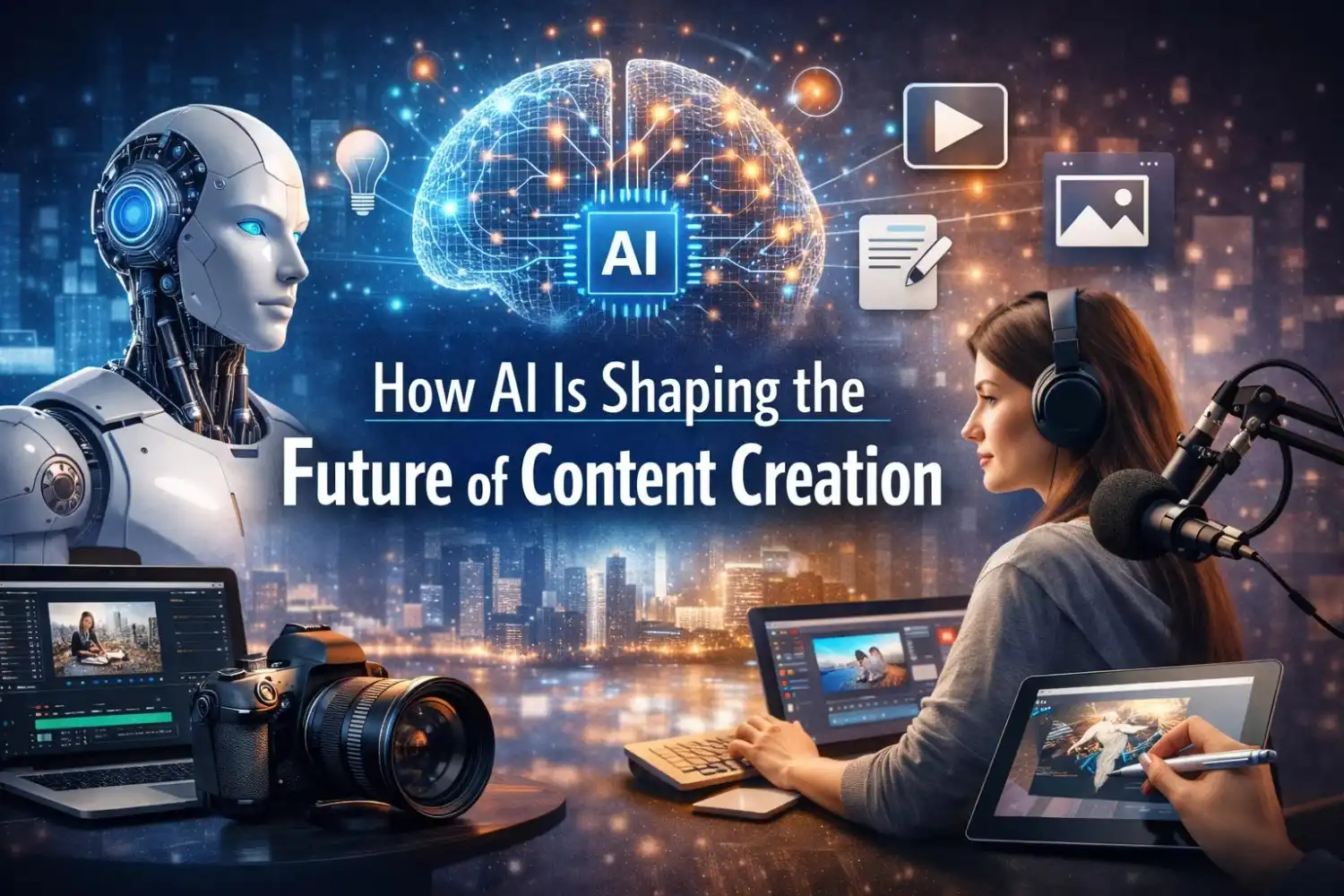
How AI Is Shaping the Future of Content Creation
The conversation around Artificial Intelligence has shifted from will it replace us? to how far it can take us? AI is no longer a tool for content creation; it is the very infrastructure upon which the digital economy is built as we navigate 2026.
For content creators, the challenge is no longer about learning how to use AI; it is about learning how to maintain a competitive advantage in a world where perfect content is now the baseline. Here are the five definitive ways AI is reshaping the future of our industry.
1. The Transition from Generative AI to Agentic AI
In the early days of the AI rise, which in turn has made us rely heavily on Generative AI to produce text based on simple prompts. In 2026, we have moved into the era of Agentic AI. These are autonomous systems that don’t just write; they research, cross-reference, as well as execute multi-step workflows.
Why Agents Change the Game
An AI agent doesn’t just draft a blog post. Also, it scans your competitors’ latest updates, identifies gaps in their arguments, pulls relevant data from your internal CRM, as well as suggests a publishing schedule based on real-time audience engagement metrics.
Strategies for Working with Agentic AI:
- Prompt Engineering to Goal Engineering: Instead of prompting Write 500 words, creators now define goals such as increasing conversion for CMOS in the healthcare sector.
- The Human-in-the-Loop Audit: Also, creators act as the final Editor-in-Chief, which focuses on ethical alignment as well as high-level strategy, while the agent manages the logistical execution.
- Workflow Integration: Popular creators are building custom GPTs or specialized agents which are trained on their specific brand voice as well as proprietary data sets.
2. Hyper-Personalization via Real-Time Dynamic Content
Additionally, static content is becoming a piece of the past. AI now allows for dynamic content generation, where a single article or landing page has the ability to switch in real-time to suit the specific individual reading it.
The End of the Average Reader
AI models can now analyze a visitor’s past behavior, professional seniority, as well as even their current local weather to adjust the tone, examples, along with call-to-action of a piece of content instantly.
Strategies for Dynamic Content:
- Modular Content Blocks: Writing content in lego bricks such as creating three versions of an intro, one for beginners, one for experts, and one for skeptics, and let the AI serve the right one.
- Behavioral Triggers: Always set AI parameters to offer deep dive technical sidebars to readers, while offering summaries to those who scan.
3. The Rise of “Interactive AI” Within Written Content
By 2026, the boundary between reading and chatting has blurred. Also, AI is transforming static text into interactive knowledge bases, where readers have the ability to engage with the article to extract personalized insights.
Transforming Passive Consumption into Active Engagement
Instead of scrolling through a 2,000-word guide, readers now have the ability to highlight a paragraph and ask an embedded AI agent to explain this using a real-world example from my industry.
Strategies for Interactive Content:
- Embedded Conversational Widgets: Integrating AI chat along with article features, helps in allowing readers to question your data without leaving the page.
- Personalized Summary Generation: The feature offers a custom summary button in which AI helps in generating an abstracted version of your article based on the reader’s specific job title or goals.
- Dynamic Data Visualizations: Utilizing AI to generate charts that update based on user inputs, as well as allowing readers to see how your advice applies to their specific numbers or timelines.
4. The Rise of Multi-Modal Content Orchestration
Further, AI has ended the barriers between text, audio, as well as video. In 2026, writing a blog post is just the first step in a multi-modal orchestration in which one core idea is simultaneously delivered in multiple formats.
The Shift to Format-Agnostic Creation
Additionally, creators are no longer just writers or videographers. They are architects of ideas as AI allows a single well researched article to be the source code for an entire ecosystem.
Strategies for Multi-Modal Success:
- Simultaneous Versioning: Using AI to instantly transform a long-form essay into a high-fidelity podcast script into a 60-second video storyboard along with an interactive data visualization.
- Voice-Cloning for Accessibility: Provide an author read audio version of every article using AI voice clones that capture your specific tone as well as emotion.
- Visual Synthesis: Using AI image generators to create custom, branded diagrams as well as infographics that explain complex concepts helps in replacing the need for generic stock photos.
5. Semantic Authority and the Concept-First Framework
As AI becomes more adept at understanding context, the importance of individual keywords has plummeted. In 2026, creators must focus on semantic authority in which building a comprehensive web of related concepts that signals total mastery of a topic to both AI bots as well as humans.
Moving Beyond the Keyword
Moreover, AI-driven search engines such as Perplexity don’t look for words; they look for entities and clusters.
Strategies for Semantic Authority:
- Contextual Linking: Ensure that internal links are based on the meaning of the destination page, which helps AI map out site’s capability more effectively.
- Topic Cluster 2.0: Creating pillar pages that serve as a central hub for dozens of hyper-specific sub-topics, as well as using AI to ensure there are no conceptual gaps in coverage.
- Linguistic Variance: Avoid recurring phrasing by using AI to identify related terminology along with synonyms that broaden the semantic field of writing, which in turn helps in making it more discoverable by advanced LLM-based search engines.
Conclusion: The Survival of the Creative
The future of AI in content creation is not just about technology; it is more about the human emotions. As AI commoditizes information, the value of insight, perspective, as well as empathy.
In 2026, the most successful creators would not be those who hide from AI, but those who use it as a force multiplier for their own unique humanity. The machines will provide the speed humans must require the most.