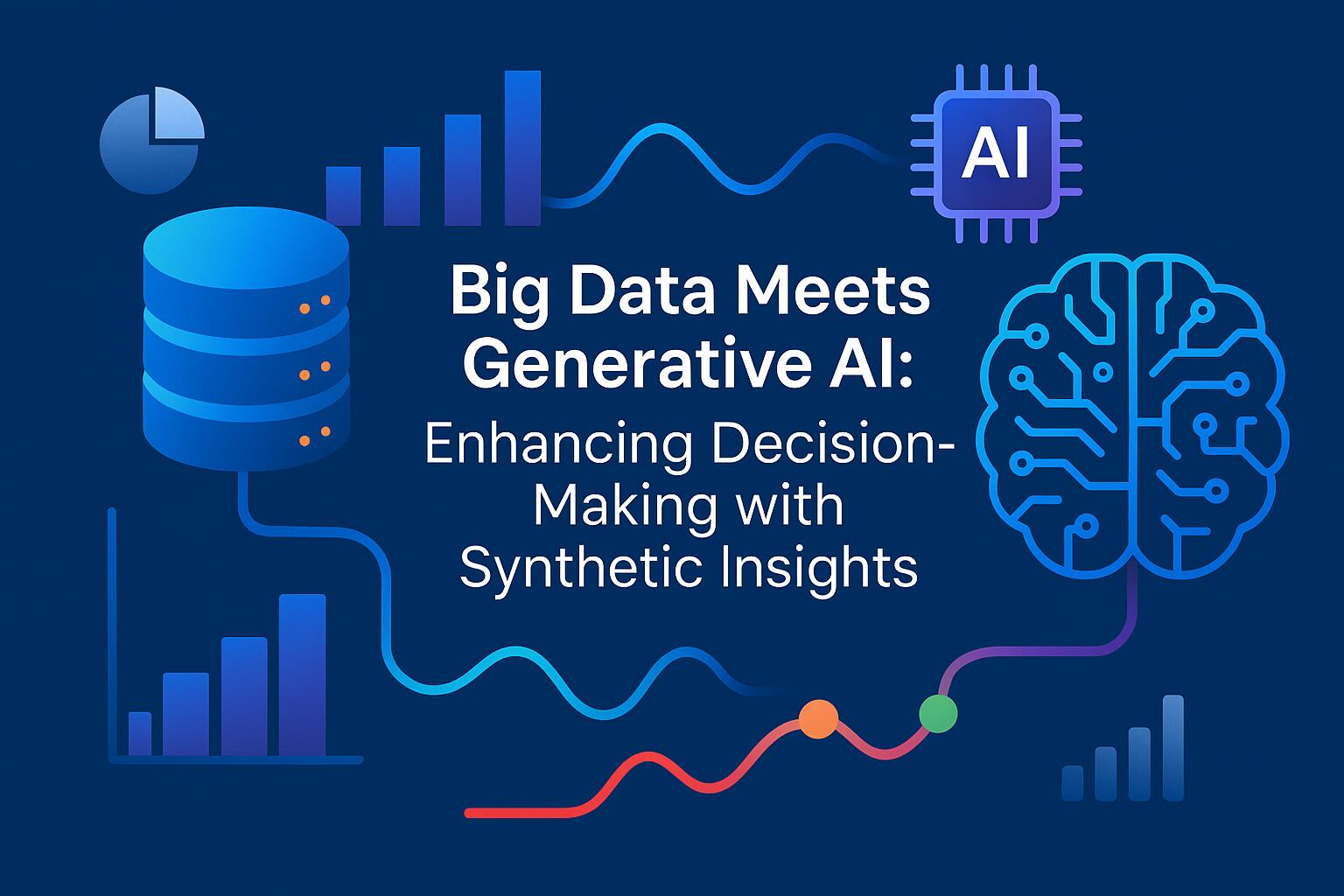
Big Data Meets Generative AI: Enhancing Decision-Making with Synthetic Insights
Big data is defined as large and complex data that is not easily processed with the help of traditional tools. It consists of customer behavior, history of previous transactions, billing records, and social media content. Big Data has the potential to provide deep insights however, it primarily drives business transformation when it is combined with Generative AI.
Together, they offer businesses a new, robust value proposition in the form of Synthetic Insights, predictions, recommendations, and simulations driven by AI to make decision-making not only faster, but smarter.
Synthetic insights provide entirely new insights based on patterns that the human could never identify. This transformational power of data can turn raw data into informed strategic foresight to help organizations outperform competitors while building stronger and more flexible data-driven strategies.
How Data and AI Are Changing Business Together?
Before AI, companies depended on data analysts to analyze company data using descriptive analytics methods to uncover past trends, and predictive analytics to measure future outcomes. That was consuming more time and experts were needed at that time.
Now we are entering a new era with AI, where it creates new ideas, content, and solutions derived from past data. AI is used to automate tasks, improve processes, and improve customer experiences, it also helps create new ways to create value. At the same time, data gives businesses insight into their customers, performance tracking, ways to remain competitive, etc.
Both AI and data facilitate companies, to take actions and make decisions in a faster and smarter way. Generative AI is not just an improvement on previous versions of AI or technology. It will entirely change and enhance the way businesses will leverage data to generate results.
What are Synthetic Insights?
Synthetic insights are an advanced form of AI-derived interpretations and recommendations. It differs from traditional analytics by not only suggesting trends but deploying synthetic data and real-time information to provide new ideas, and forecasts, that help guide the smarter business decision-making process.
Traditional tool tells you what happened, but synthetic insights will tell you why it happened, and what might happen next. This results in quicker and more precisely targeted decisions.
For example, synthetic insights can imitate the potential market response from launching a new product. It independently summarizes a group of product reviews to observe customer reaction or predict the change in customer sentiment before there is a change in the business.
By deploying data synthesis and AI, synthetic insights enable a better competitive edge in planning, marketing, and operations, enabling data to become smarter, more proactive, and actionable.
How Generative AI is Changing Big Data Analytics?
Companies are beginning to merge tools like GPT and custom large language models with big data platforms to help synthesize and make sense of complex information. These types of models can understand languages, synthesize complex reports, and even generate actual business model scenarios for business planning.
Main methods include technologies like natural language processing that is NLP for reading and interpreting text; auto-summarization for summarizing long blocks of data down to key information; synthetic scenario generation for testing “what-if” scenarios; and anomaly detection to identify early warning signs of issues or risks. This is how businesses are able to see the AI-driven insights that make the analysis process easy.
This development is a significant upgrade of big data processing with artificial intelligence. There are numerous industries that already employ this model. For example, in finance, AI assists with fraud detection and investment summaries.
In healthcare, it aids with patient diagnosis and treatment recommendations. In the supply chain, it improves forecasting and inventory planning. In marketing, it maximizes personalization and a campaign approach.
The Advantages of Synthetic Insights in Decision-Making
Here’s what Synthetic insights mean for modern business intelligence:
1. Speed: AI can analyze and summarize enormous quantities of data quickly, providing business leaders with instant answers, without any manual effort.
2. Scale: Synthetic insights can rapidly analyze hundreds of scenarios, equipping teams to assess the outcomes of those scenarios and decide on which is the right step forward.
3. Humanized Data: AI can provide an analysis in a natural language format, filtering complex data into a format that is understandable for non-technical stakeholders such as executives and managers.
4. Innovation Enablement: AI can develop new models or business situations, as it can predict the future which leads to opportunities in innovation when past data is missing.
Examples of actual use cases include:
• Healthcare: AI is used in order to help doctors predict how new patients will respond to drugs.
• Finance: Synthetic insights were utilized for market trend predictions to help firms make better-informed investment decisions.
• Retail: Brands utilize predictive trend simulations in order to make more informed stock and promotion planning decisions.
Ethical Risks in Generative AI Analytics
Although synthetic insights provide many advantages, there are also challenges that need to be managed. One of these challenges is:
1. Accuracy: sometimes generative AI produces false or totally invented information which can lead to incorrect decisions.
2. Data privacy: Privacy is another important consideration. Businesses must be mindful of privacy laws and regulations, even when using synthetic data and be cautious about potential violations involving misuse of sensitive information.
3. Biased Data: There is also the danger of data bias in generative AI. If the original data is biased, it can compromise fairness and trust in the system.
To prevent those risks, responsible AI practices must be established. This means you have experts who will assess and validate the insights given by the AI prior to taking any action. Responsible use of synthetic insights can help in making ethical, accurate, and trustworthy decisions.
Best Practices for Integrating Big Data with Generative AI
There are some best practices to consider:
1. Create a single unified data infrastructure
Make sure you have clean, organized, and connected data pipelines. Trusted data is the basis for any enterprise to be successful.
2. Customize AI for Your Business Needs
Generic models may not understand your business too well. You should fine-tune large language models with your industry-specific data in order to produce relevant and accurate insights.
3. Enable collaborative dashboards
Integrating human knowledge and expertise with AI recommendations using interactive dashboards. These dashboards allow teams to shift through AI insights and confirm them in real time.
4. Keep Your AI Models Up to Date
Generative AI must evolve with your business. Regularly check and monitor the outputs from the models to ensure they are accurate and refresh the models with data to ensure the AI is working and performing well.
Conclusion
The combination of Big Data and Generative AI is creating a new era of AI-driven decision-making. Because of synthetic insight tools, organizations will move away from basic analysis to smarter, faster, and more anticipatory strategies.
This is the turning point, and it is time for organizations to take this moment. Start utilizing the big data transformation process, to improve performance in your organization while enhancing agility and innovation.